An upright granite headstone usually runs $2,000 to $5,000, covering the die and base, the carving, and hauling it to the plot.
Before you shop for a headstone, get the section rules in writing
Common questions
Upright versus flush
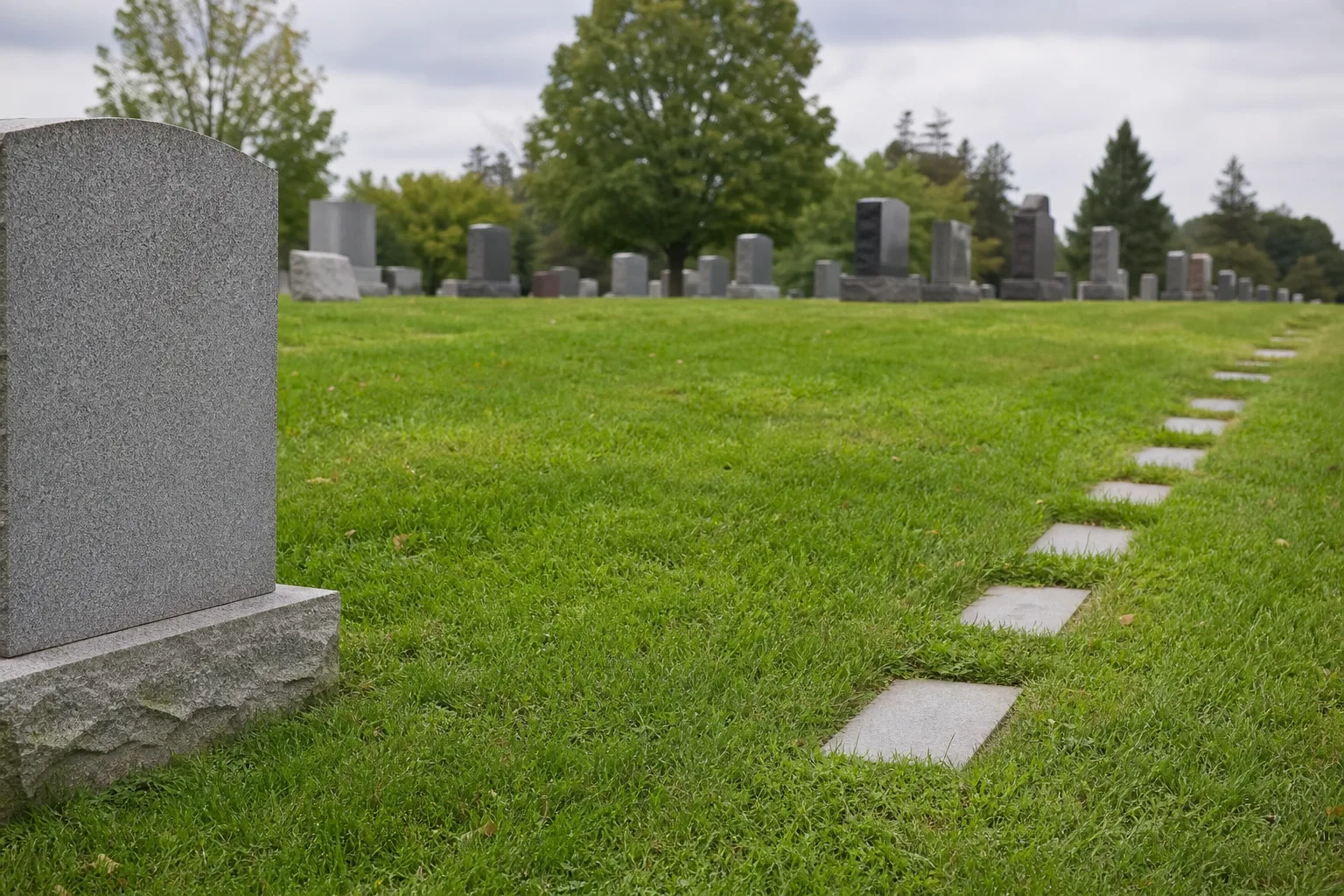
Lawn-plan sections require flush markers set level with the turf so mowing equipment can pass over them. Upright monuments are usually confined to older sections or to designated monument areas.
Color restrictions
Some sections limit granite to gray, or require a new stone to match existing family markers already on the lot. Color rules are enforced at inspection and are not resolved after cutting.
Measuring height
Check whether the stated maximum height is measured from finished grade or from the top of the concrete foundation. The difference can be several inches and can put an otherwise compliant stone over the limit.
Read next
The order that saves money runs backward from the way most families do it. Catalogs get opened first, a design gets chosen, and then someone at the cemetery office explains that the section in question takes flush bronze markers only, or that the granite has to be gray, or that the base cannot exceed a width tied to the grave itself. The monument dealer can quote anything, but the cemetery decides what may be set. Getting the section specification in writing before any shopping happens turns a long list of possibilities into a short list of buildable ones.
What the section rules actually control
Cemeteries are usually divided into sections platted at different times, and each section carries its own memorial rules. The variables are consistent even when the answers are not: whether markers stand upright or lie flush with the turf, maximum height above grade, the length and width of the base, minimum and maximum thickness of the die, permitted materials, permitted colors, and whether a vase is allowed and if so whether it must be flush, removable, or set in a specific position. Lawn-plan sections are the strictest, since the mowing crew's equipment is the reason the rule exists at all.
Color rules surprise people more than size rules do. A section may permit granite in any color, or restrict it to gray and pink, or require that new markers match a family's existing stones. Bronze sections often specify the granite base color, the bronze alloy finish, and the thickness of the plate. Marble may be excluded entirely in newer sections because of how it weathers. None of this is arbitrary, and none of it is negotiable at the counter after the stone has been cut.
Getting the specification in writing
Call the cemetery office and ask for the memorial regulations for the specific section, block, lot and grave, not for the cemetery generally. The grave identification matters because adjoining sections frequently differ. Ask for the document by email or on paper, ask whether it is the current revision, and ask whether the lot has any recorded restriction beyond the section rule, which happens when a family bought a lot with a private agreement decades ago. Ask, too, what the cemetery charges to set a marker and whether that fee is quoted separately from the foundation.
A careful reader checks a few things in that document before shopping. Whether dimensions are stated as maximums or as required sizes. Whether height is measured from the top of the foundation or from finished grade. Whether the base overhang is specified. Whether the cemetery pours the foundation itself or permits the monument dealer to do it. Whether vases are counted within the footprint. And whether the rules bind the family or the dealer, because a dealer who works the cemetery weekly usually already knows the answers and can confirm them.
Permits, foundations and the inspection
Most cemeteries require a permit application before any stone arrives. The application typically includes a scale drawing of the marker with finished dimensions, the material and color, the full inscription proof, the grave identification, and a signature from the lot owner or the person holding the right of interment. That last signature stops more orders than anything else, since ownership often sits with a relative who died years ago and the interment rights have to be transferred first. Starting that transfer early costs nothing and prevents a finished stone from sitting in a shop.
Once the permit is approved, the cemetery or the dealer pours a concrete foundation sized to the approved base, usually below frost depth in cold climates, and normally after the grave has settled. Setting is scheduled around that pour. An inspection follows, sometimes informal, sometimes documented, confirming that the stone matches the approved drawing in size, material, color and position, and that it sits level and square to the row. Discrepancies are found here, which is the argument for having the approved drawing and the section specification in the same folder.
Where the paperwork saves money
The Federal Trade Commission oversees disclosure practices in the funeral goods market, and the same instinct behind those rules applies here: get the terms in writing and compare them side by side. A monument dealer quoting against a written section specification quotes a stone that can be set. A dealer quoting against a catalog page quotes a stone that may need recutting, restocking, or replacing outright, and the family absorbs that difference. Two phone calls and one emailed document do the work.
Ask for the specification, read it closely, and shop from it.