A grave marker quote is really five prices stacked together, and only some of them belong to the person selling you the stone.
A single number arrives from the monument dealer, and it looks like the price of an object. It is not. It is five prices stacked and totaled, and only two or three of them belong to the company that answers the phone. The rest are set by the cemetery, collected by the dealer as a pass-through, and remitted with no markup and no flexibility. Understanding which line is which is the difference between negotiating usefully and arguing with someone who has no authority to move the figure you are pointing at.
The granite is the part you are choosing, and often not the biggest line
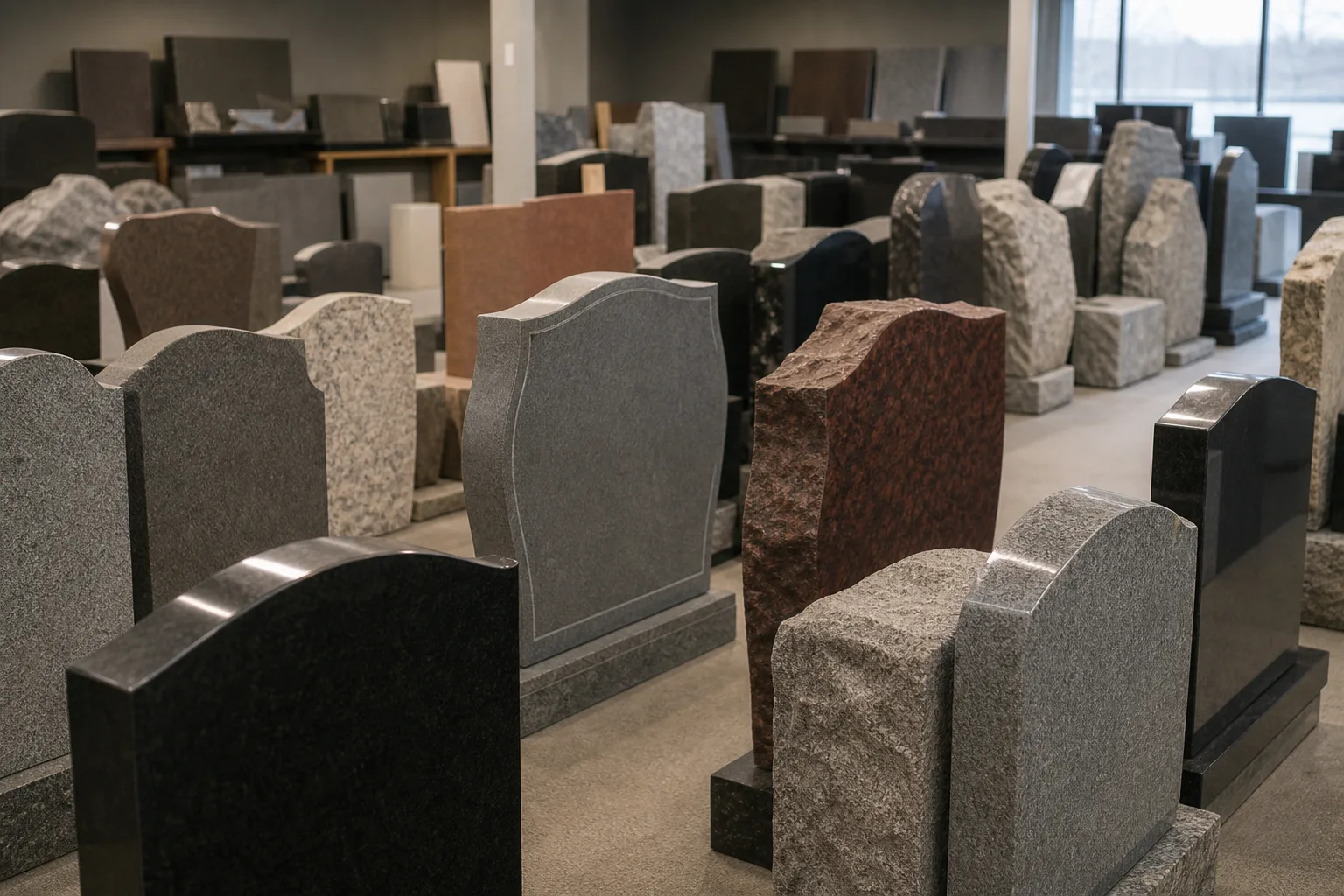
Stone cost tracks three things: cubic volume, color, and how far the material traveled. A flat marker set flush with the turf uses a fraction of the granite that an upright monument does, since an upright needs a die (the standing part) plus a base, and the base is frequently thicker and wider than the die itself. Slant markers sit in between, with a sloped face and a substantial back. Common gray and black granites from domestic quarries price lowest. Reds, blues, and heavily figured stone cost more, sometimes considerably, because supply is narrower.
The practical consequence is that shape drives price more than design does. Moving from a flat marker to a slant is a real increase; moving from a slant to a full upright with a base is another, and the two steps together commonly multiply the stone portion several times over. Adding a vase, a ledger, or a second die for a companion arrangement compounds it again. None of that has anything to do with how the stone looks when it is finished. It is volume, and volume is priced by the cubic foot at every quarry in the country.
Lettering is priced by the cut, not by the sentiment
Sandblast lettering is quoted per character or per line, and the count includes every letter, numeral, and punctuation mark in the inscription. A full name, two dates, and a short line of scripture is a modest charge. A long epitaph, a maiden name in parentheses, military branch and unit, and children's names on the reverse face is a different order of work, because the shop is cutting a second stencil and setting the stone up a second time. Carved emblems, etched portraits, and hand-shaded roses are separate line items priced by the piece and by the labor hour.
This is the most negotiable part of the whole quote, and not because dealers discount it. It is negotiable because you control the character count. Cutting an epitaph from four lines to two, dropping a laser-etched scene in favor of a standard sandblast emblem, or leaving the reverse face blank for a later inscription all reduce the figure without touching the stone you picked. Ask for the inscription quoted separately from the granite so you can see what each change is worth before you commit to the layout.
The foundation and setting fee belong to the burial ground
Most cemeteries pour their own concrete foundations and reserve the right to set anything placed on their property. Some allow the dealer's crew to set the stone under supervision, and a few require it. Either way, the foundation is priced by the footprint of the marker, which means an upright with a wide base is charged more than a flat marker of the same name and dates, entirely apart from the granite. Setting fees cover the crew, the equipment, and the leveling, and they scale with weight because a two-thousand-pound monument needs different handling than a bronze plaque on a granite mount.
Perpetual care or maintenance assessments sometimes ride along with the setting charge, particularly at older municipal and church grounds where the fee funds mowing around raised stones. When you price a headstone for grave placement, ask the office for its current foundation and setting schedule in writing before you pick a shape, because that single sheet often makes the choice for you. The Federal Trade Commission oversees funeral goods and services pricing disclosure, and asking for figures in writing is a normal request that established offices handle routinely.
Permits, inspections, and the lines that will not move
Many cemeteries charge an installation permit or application fee, review the drawing before the stone is cut, and inspect after setting. The permit is fixed, published, and identical for everyone. So is the foundation schedule, so is the setting fee, and so is whatever the ground charges for opening turf. Arguing about these with the monument dealer accomplishes nothing, since the dealer forwards the money and keeps none of it. What moves is the stone: color, size, shape, thickness, and finish. What also moves is the lettering, the number of faces inscribed, and every ornament priced by the piece.
So the useful sequence runs backward from the way most people shop. Get the cemetery's fixed charges first, subtract them from what you intend to spend, and buy stone with what remains. A family that starts with a marker they love and discovers the foundation and permit afterward finds the total has grown by a share of the budget that was never theirs to allocate. A family that starts with the office's fee sheet chooses a shape that fits the money and never has the conversation at all.
Ask for the quote itemized into five lines, granite, inscription, foundation, setting, and cemetery fees, and keep the copy. When a second dealer quotes the same job, the comparison is immediate, and the two figures that differ are the only two worth discussing.